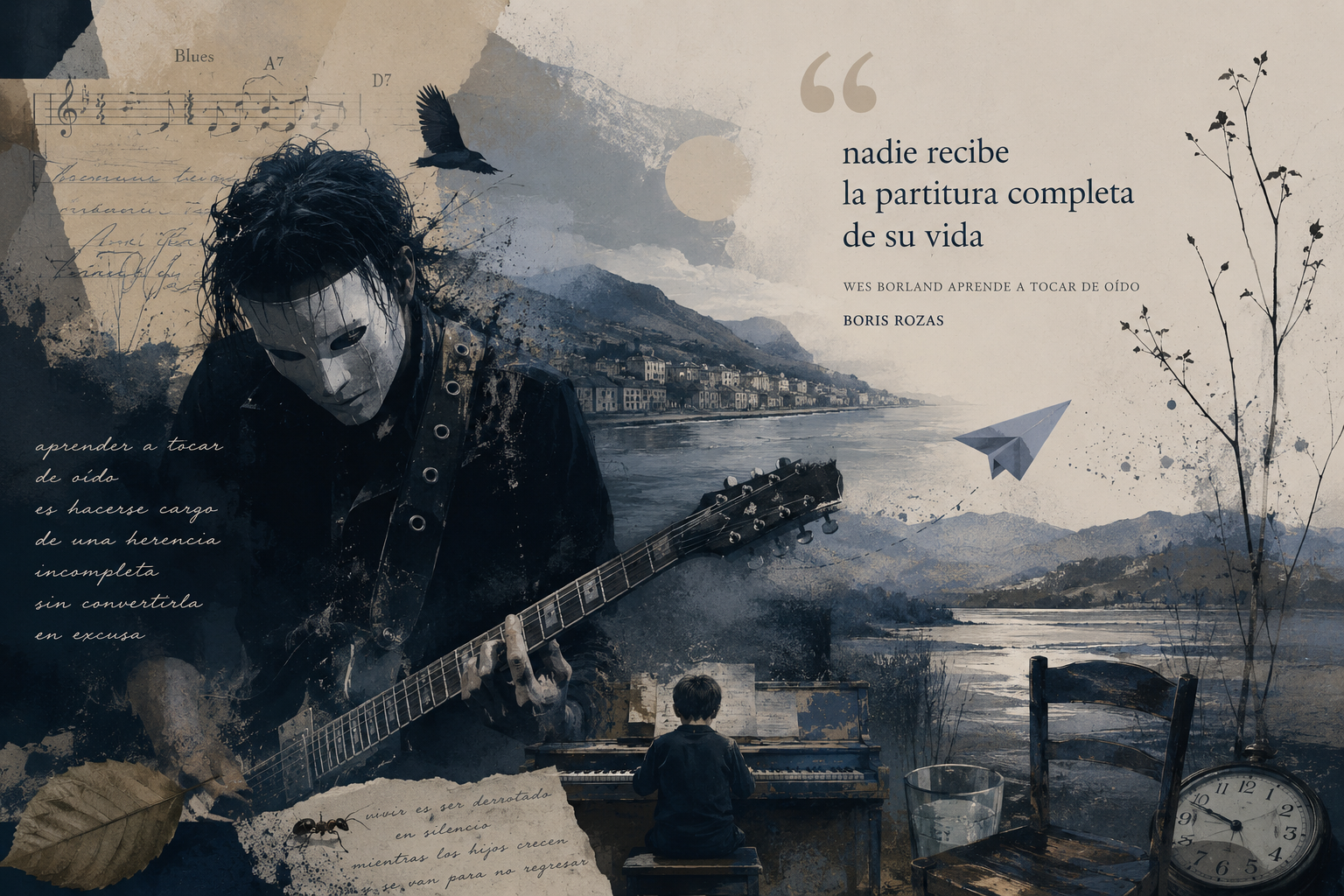
THE MASK THAT LEARNS TO LISTEN
By Juan Carlos Recinos
Before the guitar reaches the condition of noise, before the body becomes a stage and the face ceases to be a face in order to become an apparition, Wes Borland has already begun to play. Not only with his hands. He plays with the mask, with paint, with the posture of an industrial creature that transforms music into a form of physical theatre. In Limp Bizkit, where everything seemed to push toward direct impact, Borland introduced a decisive strangeness: he was not merely a guitarist, but an image, an interruption, a twisted figure within a fury that might otherwise have remained pure release. That is why the title of Boris Rozas’s book, Wes Borland aprende a tocar de oído, should not be read as a clever conceit or a simple generational reference. It is the doorway into a deeper poetics: that of someone who has no score for living and who learns, through loss, to find a possible music among the ruins.
Playing by ear: an ethics of attention
Playing by ear means accepting that life provides no method. No one receives sufficient instructions for making their way through childhood, love, the death of a father, illness, old age, parenthood, memory, or fear. No one knows, before living through it, how to hold a body together when the world breaks apart within it. In this book, the ear is not merely a musical faculty in the narrow sense: it is an ethics of attention. To listen is to survive without arrogance. It is to admit that one never fully masters what one plays. It means moving forward by trial and error, making mistakes, correcting them, and obeying a vibration that cannot yet be named. Rozas writes from that territory: not from the certainty of someone who possesses a truth, but from the exposure of someone searching for it while the poem is taking place. His poetry does not explain the noise; it learns to listen to it.
The figure of Borland is powerful because it brings together two forces that appear contradictory: mask and ear. The mask is usually understood as concealment, but here it functions as revelation. It is not a means of hiding the face, but of protecting it from the vulgarity of the obvious. Some truths cannot be spoken naked because they become sentimental, flat, too easy. They require a detour, a distortion, a form of estrangement. Something similar happens in Rozas’s poetry: emotion does not appear as immediate confession, but as an altered landscape, as animal, house, river, guitar, eyelid, wound, rain, father, son, beast. The poem does not declare: it makes things sound. And that decision saves it from facility. The mask does not cover the wound; it gives the wound a form in which it can breathe.
Three movements within a single breath
The book is divided into three movements: Detrás de nosotros todo está gris, Paralaje, and Auge y amparo de las bestias. This structure does not simply organize a collection of poems; it traces a spiritual journey. First comes the gray: not as a dead color, but as the substance of the past, the ash left behind while what has been lived is still burning. Then comes parallax: the awareness that memory changes according to the place from which it is viewed; that a family scene, a house, a mother, a road, or a loss shifts when time alters our position before it. Finally, the beasts appear: not only as an external threat, but as elemental companionship, as a dark and protective force, as that which survives when civilized forms of consolation have failed. The journey moves from shadow to perception, and from perception to a harsh form of shelter. There is no easy redemption. There is learning.
From the opening poem, Rozas raises a world in which reality seems to have lost its hinges. Morning does not enter cleanly, but like a cavern glancing sideways; days have eyelids; roads lead nowhere; monsters reign along the shore; the wind is not merely an external force, but something we ourselves have become, embarked upon the night. This inversion matters: the landscape does not surround the subject; it continues the subject. Sadness is not confessed directly; it is distributed among objects. It invades pavements, calendars, balconies, cemeteries, bodies. Pain becomes weather. Rozas does not ask for compassion for a private wound. He does something more difficult: he allows the wound to organize the world.
The wound as a form of world
There lies one of the book’s greatest virtues. Its poetry avoids sentimentality because it does not use suffering as a credential. The wound does not say: look at me. The wound works. It shifts the gaze, alters syntax, makes images strange, darkens the air. When a child appears running to camouflage himself from the wind, we are not facing a decorative scene of childhood, but a small mythology of fragility. The child hides from something that cannot be touched, yet governs everything. That child later returns in other forms: in the lover sleeping in separate beds, in the person who arrives late to his own life, in the father watching his children grow, in the body that knows itself defeated before finding a way out. Childhood, love, old age, and death are not separate themes: they are variations on the same defenselessness.
In Detrás de nosotros todo está gris, beauty carries the scent of recent ruin. Not a monumental ruin already pacified by distance, but a nearby, still-domestic ruin: a house that preserves voices, a balcony remembering emptiness, a kiss becoming history, ashes appearing among old crosses, a body seeking to stitch together the trunk of the evening. The delicacy of the book does not exclude roughness; it needs it. When Rozas succeeds, the image does not beautify damage in order to make it acceptable, but finds a music for it without lying about its violence. That is one of poetry’s lessons: do not overclean what life has dirtied.
Love appears as an acute form of listening. It is neither clean salvation nor a serene lamp. It is the loss of one’s pulse, the defeat of gentle days, a silence resonating before another silence. The book does not write against love, but against the naïveté of believing that love saves without leaving residue. Here, to love means exposing oneself to a music that can never be fully restored. The other person leaves behind a vibration, a scene, a temperature. The poem does not recover them; it prevents their absence from becoming mute. That difference is essential. Rozas’s poetry does not resurrect: it accompanies the remains. It does not promise wholeness: it fine-tunes our listening to what is incomplete.
Music as a principle of knowledge
Music does not function as a decorative theme, but as a principle of knowledge. Ballads, blues, chords, pianos, hymns, happy songs, and insufficient songs run through the volume as different ways of measuring damage. Some experiences cannot be understood through concepts, but through rhythm. Some losses allow no clean explanation, but they do allow a breath. Rozas’s verse often advances through interruptions, enjambments, associations, and accumulations that seem to seek a melody among broken materials. This appearance of disorder is not carelessness. It is controlled improvisation. The poem preserves the tremor of noise, but does not surrender entirely to noise. Its power is born from that tension.
The poem in which Wes Borland appears explicitly concentrates the book’s moral key. The guitarist learns the hard way across several states of the country; his father played blues in church from an unfinished score belonging to poor neighborhoods; the light fades in a room where both of them learn to play by ear; and those who resist dying like corpses rehearse hymns that will never appear in any book. The scene is brief, but decisive. It brings together inheritance, poverty, travel, music, spirituality, and transmission. The father does not hand down a doctrine. He hands down a way of resisting. The church does not appear as a closed institution, but as a resonating chamber. The blues, music born from a collective wound, becomes a form of breathing. The score is incomplete, but the lesson continues.
The score is incomplete, but the lesson continues.
That unfinished score is one of the volume’s most important images. No one receives the complete score of their own life. What we inherit usually arrives incomplete: gestures, silences, shame, songs, fears, unexplained phrases, ways of looking, ways of fleeing. Learning to play by ear means taking responsibility for that incomplete inheritance without turning it into an excuse. The father plays from the poor neighborhoods; the son learns in a fading light. What is passed down is not certainty, but a way of feeling one’s way forward. In that scene, the book reaches a sober truth: dignity does not always consist in winning, but in refusing to die like a corpse. That is, in refusing to accept disappearance without music.
The hymns that will never appear in any book belong to those who live without monuments. They are the songs of those who survive outside the great narratives. Rozas understands that poetry should not concern itself only with what has been consecrated. It must also listen to what will have no archive. This intuition brings the book close to a profound ethics: poetry as attention to lives that improvise a way of remaining alive when the world grants them no repertoire. Here, popular culture does not diminish the poem. It opens it. Borland enters neither as a celebrity nor as decoration. He enters as a figure of apprenticeship: someone who turned distortion into language, the mask into presence, and noise into a way of thinking about the body.
Parallax: memory shifts
Paralaje shifts the center of the book. While the first movement is dominated by the ash of what has been lived, the second introduces a more unstable gaze. Parallax means that an object appears to change position when the point from which it is observed changes. In poetry, that notion becomes a form of moral knowledge. We do not always look at what we have lost in the same way. Mother, father, house, childhood, love, the inner country each person carries within them: all change in size and light with the passage of time. What once seemed like a detail becomes central. What seemed central becomes shadow. Rozas writes from within that mobility. Memory does not preserve: it displaces.
In this second section, there appear branches, elderly people, skylights, lizards, paths, wind, the hair of old men, and a voice that can finally call out to its mother. The image is moving because it is not presented as a sentimental blow. The call to the mother comes only after the entire world has prepared its breath. Before speaking her name, the voice has had to cross branches, the dead, old people, wind, and roads. True feeling rarely appears alone. Reality must arrange itself before allowing it to emerge. Rozas knows that the deepest emotion does not always shout. Sometimes it can barely manage to say a single word: mother. And that word is enough to alter the air.
Family in this book is not a postcard. Father, mother, children, house, illness, old age, and the dead form a constellation without complacency. Family life appears as a territory where time reveals its irreversible nature. One can love and not know how to say it. One can remember and arrive too late. One can look at one’s children and understand that every closeness contains a farewell. Rozas’s poetry is valuable because it does not transform this experience into melodrama. It works through it with restraint. The first person is not displayed as the center of the world; it functions as a chamber of resonance. When it says I, it also says aging body, remembering son, watching father, losing lover, man unable to pronounce all the erased names.
Tradition, popular culture, and lived experience
That restraint distinguishes the book in an era saturated with instant intimacy. Rozas does not confuse sincerity with exposure. He does not open the wound in order to display it, but to hear what sound it produces inside a house, a landscape, a memory. This difference gives the volume dignity. There is pain, but no emotional blackmail. There is darkness, but no pose. There is culture, but no exhibitionism. H. G. Wells, Ingeborg Bachmann, Wallace Stevens, Claude Monet, Adonis, Ida Vitale, Alejandra, and Janis do not appear as trophies of reading. They enter as frequencies within a contemporary sensibility. The memory of a person today is not made only of what happened at home; it is also traversed by records, paintings, books, films, cities, and foreign voices that ultimately become part of one’s breathing.
The unity of the book is sustained because everything is subjected to the same ear. Painting becomes music; music becomes body; body becomes landscape; landscape becomes elegy. When Monet’s Woman with a Parasol appears, it does not open a museum postcard, but a scene of fragility in which back, tide, blind turtle, and storm become contaminated with one another. When Bachmann appears, there is no prestigious quotation, but a burned room in which silence remains. Rozas takes recognizable names and removes the museum glass. He returns them to exposure. That operation is one of his achievements: he understands that tradition is not honored by repeating it, but by making it breathe within a living experience.
The poetry in this book does not seek purity. It seeks mixture. Its beauty comes from crossing registers: high culture and popular culture, blues and church, painting and papaya, the stateless poet and dogs turning corners, the Sumida River and new riverbanks, the smallest house and the imagination of catastrophe. This mixture could become scattered if it were not governed by a single verbal temperature. Everything enters because everything can be heard. The risk, of course, exists: Rozas’s imagery is abundant, at times almost excessive. In some passages, accumulation threatens to obscure the poem’s line. But that excess belongs to the work’s temperament. This is not a poetry of crystal, but writing made from exposed wires. To demand absolute cleanliness would be to ask it to betray its origin. What matters is that, in its finest moments, intensity finds form.
To live, Rozas seems to say, is to pilot something that was not built to save us and nevertheless remain answerable for the flight.
One of those forms appears in the image of life as a small paper airplane that we throw each morning over every precipice at once. The image is simple and terrible. It is both childlike and tragic. Life is not a heroic ship or a powerful machine. It is a fragile object, almost made to fall, launched without guarantees over every danger. The commander of that craft has no parachute. He tries to be a man and to keep the promise he made to the wind. Few images in the book say so much with such clarity. To live, Rozas seems to say, is to pilot something that was not built to save us and nevertheless remain answerable for the flight.
Auge y amparo de las bestias: a domestic gravity
Auge y amparo de las bestias closes the journey with a domestic gravity. The house, the children, old age, illness, empty chairs, friends, ants, clocks, and everyday objects enter with the force of the end of a long day. The book no longer needs to prove its intensity; it has allowed that intensity to settle. The beasts in the title are not only external animals. They are impulses, fears, faces, remnants of ourselves. But they are also companions. They help gather up the empty chairs after the final reading. The image possesses a strange beauty: there is no pure consolation, but there is a form of fellowship with the elemental. When discourse fails, a mute presence remains and keeps us company.
The scene of the son playing piano at the entrance to a garden as small as a cemetery is one of the book’s finest. Music, fatherhood, death, and continuity come together there. The garden is not an idyll. It is a cemetery in miniature. The son plays, and the sound does not erase death, but makes it habitable for a moment. In Rozas, fatherhood is not presented as mastery or triumph, but as anticipated loss. To watch children grow is to know that life will take them beyond the house. This awareness does not destroy meaning; it deepens it. Every family music plays against the background of a future separation.
The house dying beside the river condenses the book’s maturity. Bodies are not the only things that die: spaces also grow old. Rooms become tired, walls preserve voices, objects change owners, ants claim their share, the city secures its anchors. Rozas understands that we do not live in the abstract. We live among furniture that learns our breathing, gardens that know our footsteps, pillows in which truths hide, walls upon which time leaves its gaze. That is why defeat does not appear as a general idea, but as the wearing away of what is close. An empty chair, a glass, a wall, a pillow, a house: these are not imposed symbols, but repositories of life.
Toward the end, the book reaches a harsh sentence: to live is to be defeated in silence while one’s children grow and leave, never to return. The statement does not seek consolation. Nor does it take pleasure in despair. It speaks a bitter truth without disguising it. But the poem adds the possibility that one year the tide might bring them back, and that if one strikes the wall hard enough, it might be like beginning again. That small opening prevents a nihilistic conclusion. Rozas does not promise salvation. He grants a gesture. And sometimes the most honest poetry can offer no more than that: a wall, a blow, an unlikely tide, a way of beginning again without denying defeat.
The moral coherence of a book
The greatest achievement of Wes Borland aprende a tocar de oído lies in its moral coherence. Everything returns to the ear. Love is played by ear. Memory is played by ear. Fatherhood is played by ear. Old age is played by ear. Death is played by ear. Poetry itself is played by ear because no true poet writes with the complete score of what he is about to discover. Writing is not the confirmation of a prior idea, but entering a dark room and recognizing, through resonance, which objects are still alive. Rozas does not look at existence from above. He listens to it from below: from the floor, from the wood, from the throat in which a song persists even though no one asked for it.
The darkness of the book is organic. In much recent writing, darkness is used as a substitute for depth. Not here. The shadow is a consequence. The poem becomes dark because the experience it is trying to hear cannot arrive in any other way. That distinction sustains the dignity of the whole. Rozas knows that some truths become false when spoken too soon or too clearly. That is why he circles his images, allows them to vibrate, and lets meaning appear as reverberation. Reading Rozas requires accepting that clarity does not always arrive as a lamp; sometimes it arrives as an echo.
This quality gives the volume its elegiac force. True elegy does not consist in mourning what has been lost, but in finding a verbal form capable of not betraying it. In Rozas, what has been lost does not remain still. It changes bodies: it becomes animal, music, house, river, father, son, city, rain. What has been lost accompanies us. Poetry resurrects nothing, but it prevents everything from dying in the same way. It distinguishes the remains. It listens to their tones. It recognizes that even ruin preserves a secret modulation.
A metaphor for the contemporary poet
In the end, Wes Borland ceases to be merely the painted guitarist from a band of downtuned guitars and confrontational energy. He becomes a metaphor for the contemporary poet: someone who knows that purity is impossible, that the face must pass through the mask in order to speak a less obvious truth, that music is often born from a deformed region, that technique is insufficient unless the body has learned to listen. Learning to play by ear means accepting that there will be no score for grief, no method for love, no handbook for old age, and no grammar sufficient for death. There will only be attention, trial and error, a hand searching for the least false chord in the darkness.
Wes Borland aprende a tocar de oído is ultimately a book about the dignity of improvising without abandoning form. Its beauty comes from making music out of damaged materials. It matters not because of its cleanliness, but because of its fidelity to what it hears. It has edges, accumulations, areas of shadow, rough breaths; that is precisely where its truth lies. Poetry appears as a cable still carrying electricity among the ruins. Boris Rozas has written a volume in which sadness does not become ornament, but a test of one’s ear. What survives is neither innocence, nor fullness, nor an easy hope. What survives is a low, stubborn, human music: the music of those who, even without a score, refuse to die like corpses.
Published on May 13, 2026, in CULTURAMAS.

