By Carlos Avanzó
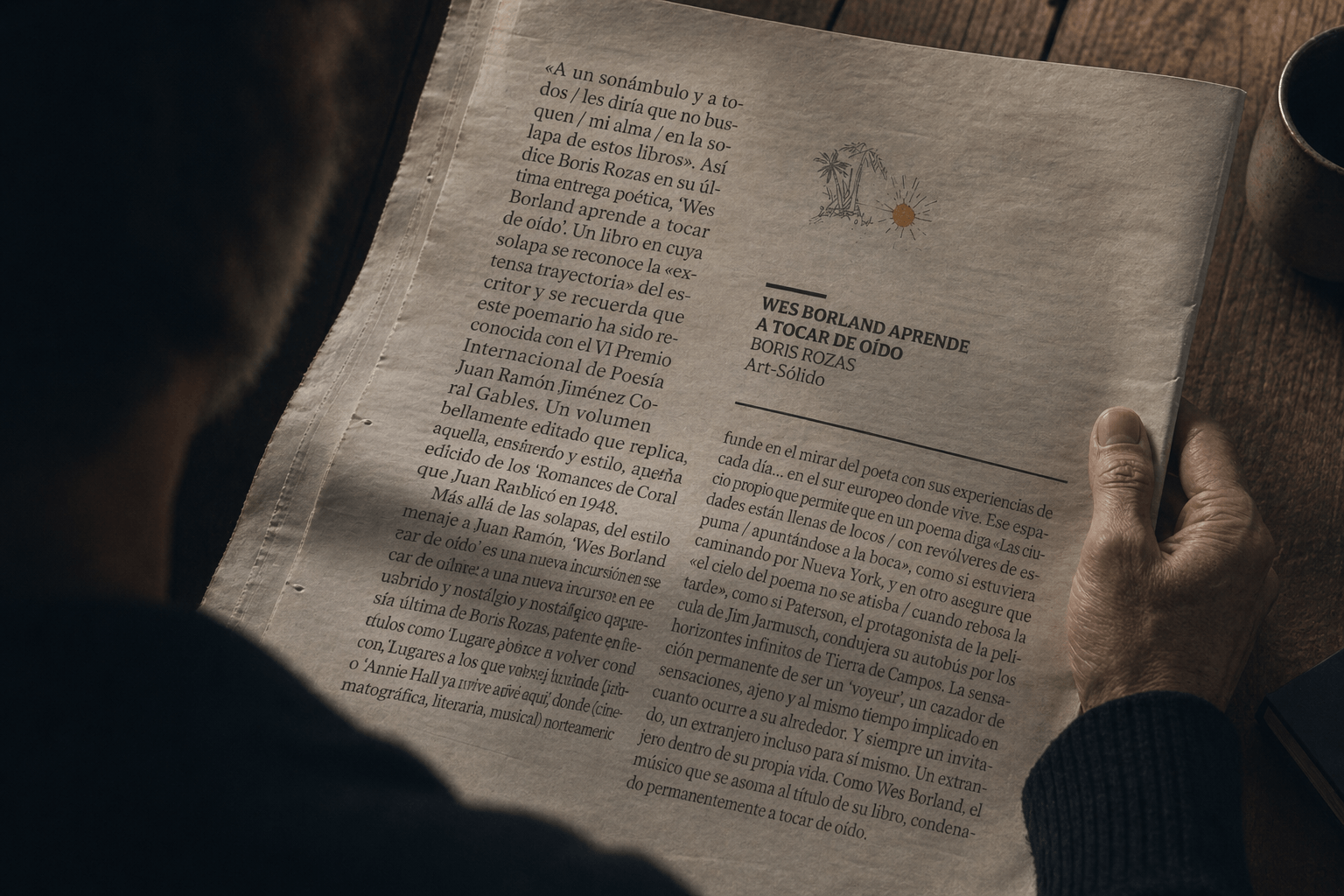
“To a sleepwalker and to everyone / I would say: do not look / for my soul / on the dust jackets of these books.”
So writes Boris Rozas in his latest poetry collection, Wes Borland aprende a tocar de oído. The book’s dust jacket acknowledges the writer’s “extensive career” and notes that the collection received the VI Juan Ramón Jiménez International Poetry Prize of Coral Gables.
A beautifully produced volume that echoes, in both design and style, the edition of Romances de Coral Gables published by Juan Ramón in 1948.
Beyond the dust jackets, the graphic style, and the tribute to Juan Ramón, Wes Borland aprende a tocar de oído marks another journey into the urban, stark, and nostalgic world that surrounds Boris Rozas’s recent poetry, also evident in works such as Lugares a los que volver con el buen tiempo and Annie Hall ya no vive aquí.
In these books, American culture—cinematic, literary, and musical—blends with the poet’s perception of his everyday experiences in the southern European landscape where he lives.
This personal territory allows him to write in one poem:
“Cities are full of madmen / with foam revolvers / pointed at their mouths”
as though he were walking through New York, and to declare in another:
“the poem’s sky cannot be glimpsed / when the afternoon overflows”
as though Paterson, the protagonist of Jim Jarmusch’s film, were driving his bus across the endless horizons of Tierra de Campos.
There is a constant sense of being a voyeur, a hunter of sensations, detached from and yet involved in everything taking place around him. Always a guest, a foreigner even to himself. A foreigner within his own life.
Like Wes Borland, the musician who appears in the title of his book, forever condemned to play by ear.
Published on April 19, 2026, in El Norte de Castilla.

